By: Casey L. Bradley, Ph.D. – December 4th, 2024; President and Founder of Animistic
Holiday traditions hold a special place in our hearts and on our plates. In the United States, Thanksgiving is synonymous with turkey, while Christmas tables are often graced by the rich flavors of ham or other specialty meats. But have you ever paused to consider the broader impact of these culinary customs on the economy, environment, or your diet?
Both turkey and pork production play crucial roles in the U.S. agricultural economy, contributing nearly $34 billion annually. Of this, pork accounts for 80% of the economic impact.
Despite pork’s dominance in market value, turkey holds its own as a holiday favorite, with Americans consuming an average of 14.8 pounds of turkey compared to 52.3 pounds of pork annually in 2023.
Beyond economics, the environmental footprint of these meats sparks an interesting comparison. Greenhouse gas (GHG) emissions from pork production are highly variable but range between 2.6 to 5.0 kg CO₂e per kilogram of carcass weight, depending on operational specifics (Liu et al., 2013). In contrast, turkey production is less GHG-intensive, with emissions averaging 1.92 kg CO₂e per kilogram of carcass weight (Vergé et al., 2009). The disparity is primarily attributed to differences in manure management systems—liquid for pigs versus solid for turkeys—and their respective feed efficiency. Regarding nutrition, the choice isn’t as simple as turkey or ham. Turkey’s white and dark meat offer distinct profiles: white meat boasts fewer calories and fat with more protein, while dark meat is richer in micronutrients like iron and zinc (Table 1). Ham, a delicious middle ground, provides balanced nutrition but often comes with high sodium content due to processing and curing—a factor worth considering for those watching their salt intake. As Dr. Casey Bradley, Animistic’s founder, often reminds us, “Everything in moderation.” While she favors ham, she acknowledges the nuanced nutritional differences between these two-holiday staples.
The production requirements for both types of meat are also remarkably similar. It takes approximately 3.6 pounds of feed to produce a pound of meat for either pigs or turkeys. However, their nutritional needs diverge significantly—turkeys require diets with higher levels of crude protein and fat compared to pigs.
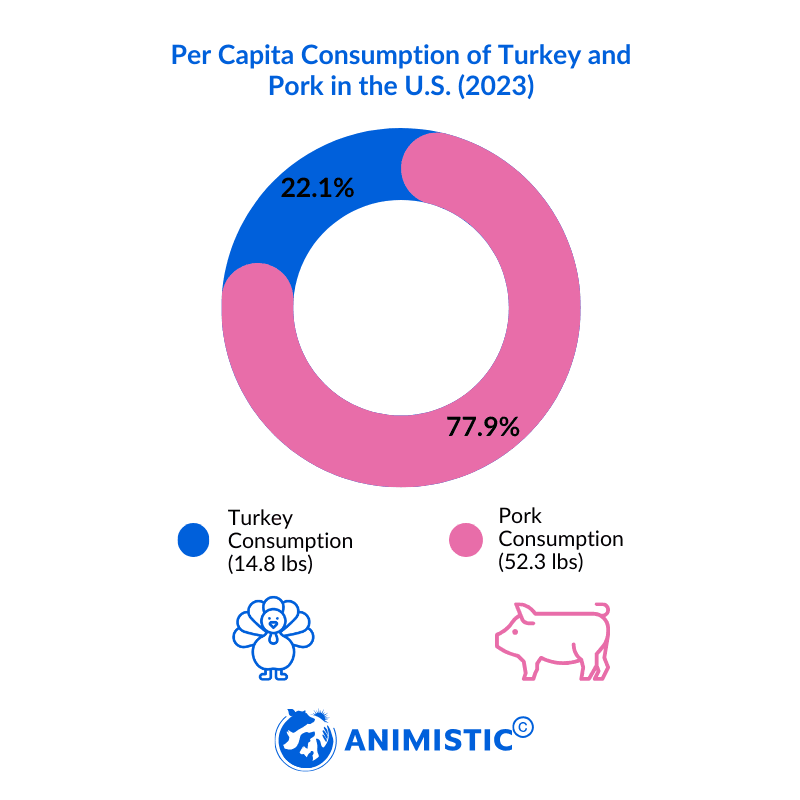

Figure 2. USA Economic Value (A) and Consumption Trends (B) of Turkey versus Pork Production over the last five years are presented. (Sources ers.udsda.gov, statista.com, and nppc.org)

It’s no secret that Dr. Casey Bradley is a true multi-species nutritionist, building a team with expertise across diverse species to support animal agriculture. Early in her career at Kalmbach Feeds, Inc., Dr. Bradley had the unique opportunity to formulate diets for both swine and turkey producers. This presented a learning curve, as her academic training at the University of Arkansas, under experienced Poultry Science professors like Dr. Craig Coon, primarily focused on broiler production.
Dr. Bradley recalls a particularly eye-opening conversation with a seasonal turkey producer:
“What do you mean the turkeys are growing too fast? You want me to slow down their growth?”
The producer, preparing to double their turkey capacity for the Thanksgiving season, faced a unique challenge. Their turkeys were performing so well—with above-average average daily gain (ADG)—that they risked growing too large for their customers’ ovens! This anecdote highlights a key distinction between swine and poultry nutrition. Unlike swine operations, where producers sell multiple loads or cuts to hit target weights, broilers and turkeys are typically raised with a fixed grow-out period.
At Animistic, we tailor formulation programs to meet the specific needs of each producer. For instance, our work with Grass Roots Farmers’ Cooperative involves monthly monitoring of live and carcass weights, ensuring nutritional adjustments are aligned with desired average weights. In these cases, performance isn’t just about ADG; greater value often comes from improved livability and reduced condemnations at the processing plant.
While turkeys and swine have different growth patterns, they share common challenges: uniformity and livability. This is where Animistic excels. Dr. Bradley’s extensive experience in research and development enables her team to address these issues holistically, from optimizing diets for energy, amino acids, minerals, and vitamins to strategically incorporating feed additives.
Looking ahead, Animistic is poised to elevate its support for producers even further. In 2025, we will launch our Performance Packs, designed specifically for different species and production systems. These packs will leverage Dr. Bradley’s 20+ years of expertise in feed additive research and development, offering producers practical solutions that deliver measurable results—without breaking the bank.
As you gather with loved ones this holiday season, consider making your meal even more meaningful by supporting sustainable agriculture and small-scale farmers. Animistic proudly partners with Grass Roots Farmers’ Cooperative, a network of passionate producers dedicated to delivering the highest quality meats while prioritizing environmental stewardship and animal welfare.
Whether you’re looking for a perfectly cured ham, a free-range turkey, or another centerpiece to grace your holiday table, Grass Roots Cooperative offers a range of ethically sourced, nutrient-rich options. Every product is traceable back to the farm, ensuring you know exactly where your food comes from and the care that went into its production.
By choosing Grass Roots Cooperative, you are not just serving a meal—you are supporting small farmers and sustainable practices that align with Animistic’s mission to serve faithfully through science plus heart.
Order your holiday meat dish today and make this season one to remember: Grass Roots Farmers’ Cooperative
Lu, Z.; W. Powers, and H. Liu. 2013. Greenhouse gas emissions from swine operations: Evaluation of the Intergovernmental Panel on Climate approaches through meta-analysis. J. Anim. Sci. 91: 4017-4032. https://doi:10.2527/jas2012-6147.
Vergé, X. P. C.; J. A. Dyer, R. L. Desjardins, and D. Worth. 2009. Long-term trends in greenhouse gas emissions from the Canadian poultry industry. J Applied Poultry Res. 18(2): 210-222. https://doi.org/10.3382/japr.2008-0009.