By: ANIMISTIC Team - November 12th, 2025 Last year, we carved into one of the season’s greatest debates: Turkey vs. Ham — a friendly food face-off that stirred hearts,
appetites, and family traditions across the table.
This year, we’re shifting the spotlight from the main course to the sides that complete every holiday feast. Whether you’re Team Mashed Potatoes or Team Sweet Potato Casserole, the battle for the best dish is far from over.
Both are creamy, comforting classics rooted in centuries of history and nutrition. But beneath the buttery layers and toasted marshmallows
lies a deeper story — one of agriculture, culture, and even pet nutrition. After all, at Animistic, we believe good food nourishes every member of the family, two-legged or four.
So grab your fork (and maybe a dog treat for your furry sous-chef) as we dig into the science, tradition, and flavor behind two of America’s favorite holiday staples.
Potatoes have traveled quite the journey before earning a permanent place on our holiday tables. Originally cultivated in the Andean regions of South America, potatoes were introduced to Europe in the late 1500s, where they quickly became a staple food source for entire populations. Their ability to grow in diverse climates and provide high caloric yield made them invaluable, sustaining families from Ireland to Poland and shaping agricultural economies across the continent.
By the 1600s, European settlers brought potatoes to North America, planting them first in New Hampshire, though they didn’t immediately win American hearts. Fun fact: despite their status as a lifeline crop overseas, the potato wasn’t widely accepted in America until President Thomas Jefferson served them at a White House dinner in the early 1800s. From that moment on, their popularity took root across the nation.
Today, families continue that legacy—gathering around their tables, debating side dishes, and consuming an estimated 214 million pounds of potatoes during Thanksgiving dinners alone.
Potatoes (Solanum tuberosum) and sweet potatoes (Ipomoea batatas) remain two of the world’s most consumed root vegetables. Though they share a spot on the same plate, they come from entirely different families: white potatoes belong to the nightshade family, while sweet potatoes hail from the morning glory family.
And just to clear up a common mix-up—what’s labeled a “yam” in most U.S. grocery stores is actually a variety of sweet potato, rebranded for marketing appeal decades ago.
Versatile, affordable, and nutrient-rich, both potatoes and sweet potatoes continue to play vital roles in global food security and agricultural sustainability, feeding billions and connecting cultures across centuries.
From small family farms to large-scale agricultural operations, potatoes and sweet potatoes remain cornerstone crops in both American and global food systems. Their adaptability across various climates and soils has enabled them to thrive in nearly every corner of the world — from the highlands of Peru to the plains of the Midwest.
In the United States alone, over 200 potato varieties are cultivated, showcasing an impressive range of flavors, textures, and uses. The most common market types include russet, red, white, yellow, and petite potatoes — each favored for specific culinary uses, from fluffy baked russets to creamy red potato salads.
Sweet potatoes, meanwhile, are typically classified by the color of their skin and flesh, with five main types:
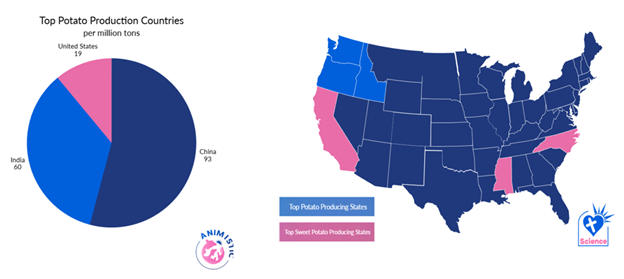
While sweet potatoes flourish in warmer southern states like North Carolina, Louisiana, and Mississippi, traditional white potatoes are grown across more than 38 U.S. states, with Idaho, Washington, Wisconsin, and Maine leading the way. Together, they contribute billions to the agricultural economy each year, providing a sustainable and nutrient-dense food source for both humans and animals.
Globally, potatoes rank among the top five most produced crops, feeding millions and serving as a critical component of food security programs. Their efficiency — producing more food per acre than nearly any other staple crop — continues to make them a vital resource in combating hunger and improving rural livelihoods worldwide.
Despite their differences in flavor and appearance, russet and sweet potatoes share more similarities than you might expect. Both are rich in complex carbohydrates and essential micronutrients, making them reliable sources of sustained energy for the body.
White potatoes are excellent sources of potassium, vitamin C, and B-complex vitamins, supporting muscle function, immunity, and metabolism. Sweet potatoes, on the other hand, are packed with beta-carotene—a precursor to vitamin A—along with fiber and antioxidants that promote gut and eye health.
Sweet potatoes naturally contain a touch more sugar, giving them that mild sweetness many associate with comfort food, while russet potatoes—especially when the skin is left on—deliver similar energy and mineral value, as most nutrients are concentrated in the peel.
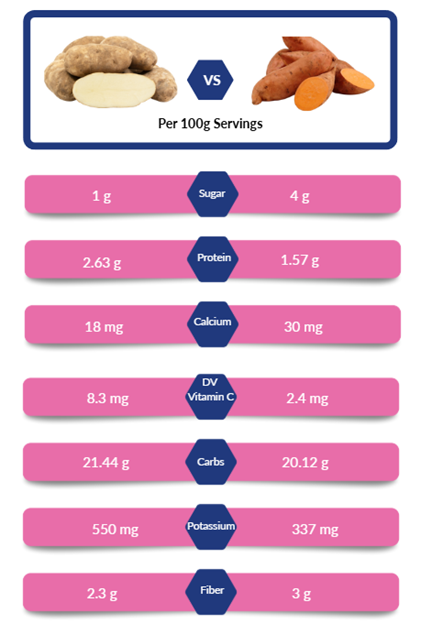
Figure 2. Nutritional Comparison Between Russet and Sweet Potatoes (Per 100 g Serving)
This visual highlights the key nutritional differences between russet and sweet potatoes—the two most commonly consumed varieties. While russets provide slightly more potassium and vitamin C, sweet potatoes deliver higher fiber and exceptional vitamin A levels, thanks to their beta-carotene content.
When it comes to nutrition, the biggest factor isn’t the potato—it’s the preparation.
· Sweet Potato Casserole: When baked or mashed with minimal added sugar and fat, sweet potatoes can be a nutrient-dense side dish. Add marshmallows, brown sugar, or heavy butter, however, and calories rise quickly while nutrients take a back seat.
· Mashed Potatoes with Gravy: Plain mashed potatoes, made with limited butter, salt, and cream, maintain much of their nutritional integrity. It’s the gravy and rich dairy that tend to load the dish with sodium and saturated fat.
From a culinary and dietary standpoint, sweet potatoes have a slight nutritional edge due to their higher beta-carotene and fiber content, yet both can be part of a balanced diet when enjoyed in moderation. Whether mashed, baked, roasted, or whipped into a casserole, these humble roots remain nutrient-packed staples—and, let’s be honest, tater-ly irresistible during the holidays.
We can’t fur-get our four-legged family members! Pet nutritionists often favor sweet potatoes in canine diets because they’re rich in dietary fiber that supports a healthy gut microbiome, and they contain beta-carotene, a precursor to vitamin A that supports immune and eye health. These nutrients make sweet potatoes a paw-some ingredient for maintaining digestion and vitality in dogs.
While some pet foods include other potato varieties as a carbohydrate source, they’re typically chosen for their lower cost rather than their nutritional superiority. Regardless of type, potatoes must be fully cooked before feeding as raw potatoes contain solanine, a compound that can be toxic to dogs. Proper cooking neutralizes this compound, making the starches more digestible and safer for canine consumption.
In moderation, both potato types can provide a great source of energy, vitamins, and minerals for dogs. Just be sure to skip the butter, salt, and gravy (no matter how much they give you the puppy eyes). Sweet potatoes, especially when baked or dehydrated, make excellent chew treats that support digestive health and satisfy that natural urge to chew.
So, while your family debates mashed vs. casserole this holiday season, remember that your furry friends might already have their favorite side, one that’s both delicious and tail-waggingly nutritious. After all, when it comes to feeding your pup, it’s spud-tacular to choose smart!
No Animistic holiday would be complete without a touch of Dr. Casey’s kitchen chemistry. Her signature sweet potato casserole and perfectly whipped mashed potatoes are long-time family favorites — proof that science and heart pair just as beautifully in the kitchen as they do in nutrition.
Download Dr. Casey’s Holiday Recipe Cards to bring a little Animistic warmth (and a lot of butter) to your own table this season.
👉 Download the Recipe Cards (PDF)
Recipes:
This recipe isn’t measured in milligrams or precise formulas—it’s about balance, taste, and joy.
Base Ingredients:
· ~2 lbs sweet potatoes
· 2 sticks butter
· Crushed pineapple
· Pumpkin pie spices (be generous!)
· ½ cup brown sugar
· Cinnamon (also generous!)
· A splash of milk
Topping Options:
· Classic: Mini marshmallows for that nostalgic holiday touch
· Nutty twist: 1 stick butter, brown sugar, and chopped pecans for a caramelized crunch
Directions:
1. Combine the base ingredients and blend until smooth.
2. Add your topping of choice.
3. Prepare the night before, then bake at 350°F for about 1 hour on the big day.
4. Serve warm, smile often, and accept all compliments graciously.
“My recipe isn’t an exact science—it’s taste-tested, family-approved, and perfected by instinct.”
— Dr. Casey Bradley
Sometimes, the simplest things are the best things—especially when they’re made with heart (and a bit of elbow grease).
Ingredients:
· Yukon Gold potatoes
· Butter—lots of it
· Milk or whipping cream
· Salt to taste
Directions:
1. Boil until tender.
2. Add butter and cream.
3. Then—beat the ever-living daylight out of them until smooth and creamy perfection.
“It’s not an exact science; it’s an art. Taste, adjust, repeat.”
At Animistic, we believe the best traditions start with curiosity — and a dash of creativity. Whether it’s Dr. Casey’s sweet potato casserole, her family-famous mashed potatoes, or a batch of our Pumpkin Dog Treats baking in the oven, food has a way of bringing everyone — people and pets — together around the same table.
The same philosophy guides our work in animal nutrition and product development. Every great formulation starts with a spark of innovation — a blend of science, imagination, and purpose — that leads to healthier animals and stronger businesses.
So if you’re looking to develop a new product, explore a market opportunity, or reimagine what’s possible in animal diets, we’re here to help you mix the right ingredients for success.
✨ Let’s build the next great nutrition tradition together.
👉 Connect with Animistic